
A former Nazi concentration camp secretary, 96, faces a German court on Thursday for her alleged complicity in the murders of 10,000 people.
Irmgard Furchner was a teenager when she worked in the camp director's office at Stutthof, in occupied Poland, near the city known today as Gdansk. She is the only woman to stand trial in recent years over crimes dating to the Nazi era.
Ms Furchner “assisted those responsible at the camp in the systematic killing of Jewish prisoners, Polish partisans and Soviet Russian prisoners of war in her function as a stenographer and secretary to the camp commander” between June 1943 and April 1945, AFP reported, citing prosecutors.
A minor at the time of the alleged crimes, she is charged with “aiding and abetting murder in more than 10,000 cases”, as well as complicity in attempted murder.
Despite her age, the accused, who lives in a care home near Hamburg, was declared fit to stand trial but has yet to respond to the accusations.
The proceedings will open a day before the 75th anniversary of the end of the Nuremberg trials, in which prominent members of the Nazi establishment, including Hermann Goering, were held to account.
But time is running out for prosecutors seeking to bring former members of the SS, the Nazi paramilitary group that oversaw mass executions, and their functionaries, as the wartime generation disappears.

A week after the start of the hearings in Itzehoe, the trial of a 100-year-old former camp guard accused of being an accessory in the murder of more than 3,500 people will begin in Neuruppin, in the eastern state of Brandenburg.
Prosecutors are handling a further nine cases, while the body responsible for investigating Nazi crimes looks into seven others.
At issue is Ms Furchner's “concrete responsibility” in the killings, a spokesman for the prosecutors told AFP earlier this year, a question they tasked historians with assessing.
As a secretary working in the camp, Ms Furchner “handled all the correspondence” for the SS commander Paul Werner Hoppe, said Christoph Rueckel, a lawyer representing Holocaust survivors, many of whom are parties in the trial.
“She typed out the deportation and execution commands” at Hoppe's dictation, Mr Rueckel told public broadcaster NDR.
For Ms Furcher's lawyer, Wolf Molkentin, it is not clear that she knew and understood the fate that awaited the prisoners.
-
-
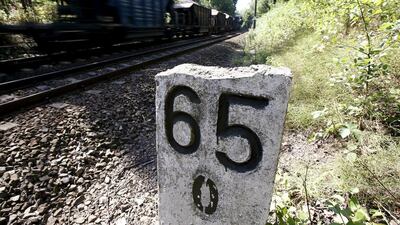
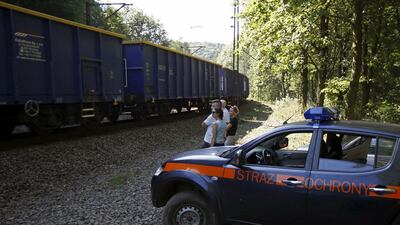
Poland said on Friday it was almost certain it had located the Nazi train rumoured to have gone missing near the end of the Second World War loaded with guns and jewels. Kacper Pempel/Reuters -
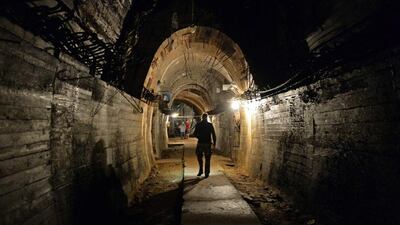
Men walking in the underground galleries, part of Nazi Germany “Riese” construction project under the Ksiaz castle in the area where the Nazi gold train is supposedly hidden underground, in Walbrzych, Poland. Janek Skarzynzki/ AFP Photo -
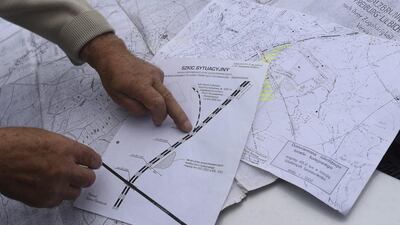
Tadeusz Slowikowski, a local explorer, points on map of the area where a Nazi train is believed to be at. Kornelia Glowacka-Wolf, Agencja Gazet/Reuters -
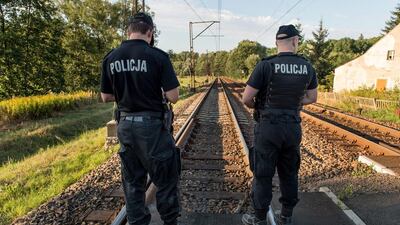
Police officers patrolling the railway tracks on a line between Walbrzych and Wroclaw, in Walbrzych’s suburbs, Poland. Maciej Kulczynski/EPA -
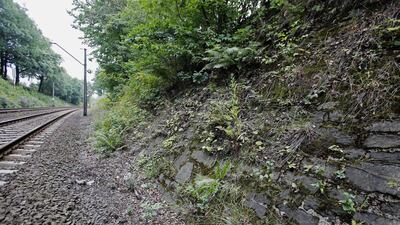
A regional governor in Poland said on Monday he had serious doubts about the alleged discovery days after a deputy culture minister revealed he was “more than 99 per cent sure” one had been found. AP Photo -
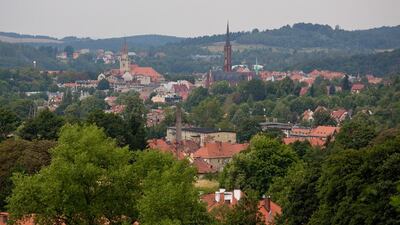
A general view of the city of Walbrzych, Poland, Friday, Aug. 28, 2015, near which a Nazi gold train is believed to be hidden. AP Photo -

Tomasz Smolarz, left, governor of the southwestern region of Lower Silesia, said “There is no more proof for this alleged discovery than for other claims made over the years.” Maciej Kulczynski/EPA -

Polish authorities on Monday blocked off a wooded area near a railroad track after scores of treasure hunters swarmed southwest Poland looking for the alleged Nazi gold train. Kacper Pempel/Reuters -
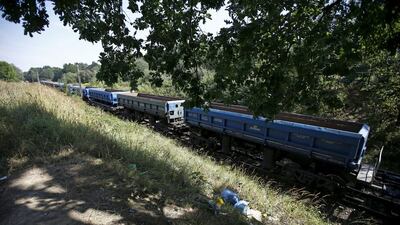
“Half of Walbrzych’s residents and other people are going treasure hunting or just for walks to see the site. We are worried for their security,” police spokeswoman Magdalena Koroscik said. Kacper Pempel/Reuters


Communication between SS officials was “so coded that a secretary was not necessarily able to decipher it,” he told the German weekly Spiegel.
“It's possible that a typist like Mrs Furchner was screened off” from what was happening at the camp, he said.
“The role of women in the Nazi regime and their implication in the Holocaust has for too long been ignored by justice,” historian Simone Erpel told Spiegel.
Responsibilities normally held by women in the Nazi system were generally considered outside the scope of prosecutors until a landmark decision in 2011, when John Demjanjuk, a guard at a concentration camp, was convicted for serving as part of the Nazi killing machine.
Since then courts have handed down several guilty verdicts in similar cases, not just for murders or atrocities directly linked to the individual accused.
In the most recent verdict, a former SS guard, Bruno Dey, was found guilty at 93 and given a two-year suspended sentence.
As the court handed down Dey's verdict in July 2020, he apologised to Holocaust victims, saying “something like this must never happen again".
Dey worked in the same Stutthof camp as Ms Furchner, set up by the Nazis in 1939.
It ended up holding 110,000 detainees, including many Jews. About 65,000 people perished at the camp.

